
This is one of those things that feels obvious once you say it out loud, but somehow it still gets missed on a lot of projects. BIM should follow construction. Not the other way around.
Somewhere along the line, BIM started getting treated like its own separate thing instead of an extension of how the building is actually going to be built. And that’s usually where projects start going sideways.
BIM is not just modeling for the sake of modeling
BIM is supposed to support construction. Period. It’s not about making a pretty model. It’s not about checking a box. It’s about helping the field install work with fewer questions, fewer surprises, and fewer things that need to be ripped out and redone.
If BIM is being coordinated in an order that doesn’t match the construction sequence, you’re already creating problems for yourself.
Sequencing is not optional
Buildings get built in a specific order for a reason. Systems stack. Trades depend on each other. You can’t just jump around the building and expect everything to magically line up later. The same logic applies to BIM.
If construction is moving from the bottom up, BIM should be coordinated from the bottom up. If construction is phased by area or wing, BIM should follow that same phasing. When coordination ignores that reality, you end up making decisions without the full picture. And those decisions almost always come back to bite you.
Buildings get built in a specific order, and BIM has to follow that same order.
— Tawney Vaughan, Electrical BIM Manager
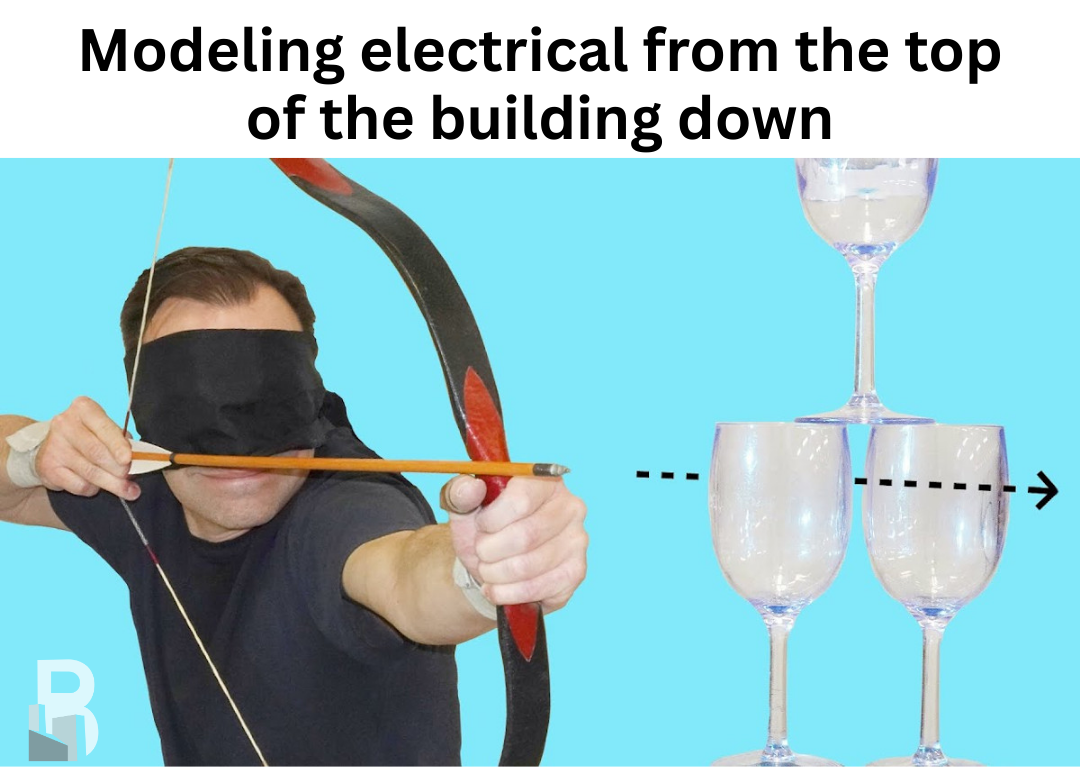
Original photo from Nerdist
Why this is especially painful for electrical
Electrical tends to get the short end of the stick here. A lot of projects want to start coordination at the roof because that’s where rooftop units live. From a mechanical standpoint, that can make sense. From an electrical standpoint, it usually doesn’t.
Most electrical systems start in the basement. Switchgear, panels, feeders, main pathways. Everything branches out from there. If you force electrical to coordinate from the roof down, you’re asking them to design without knowing how the system actually starts. You can’t know what needs to get to the roof if you haven’t built the system from the source. That’s how you end up with routing that looks fine in isolation but doesn’t work once everything else gets added.
BIM is supposed to stay ahead of the field
The whole point of BIM is to beat the field. If coordination is still happening while crews are installing, you’re losing ground fast. At that point, the field has to make decisions in real time. They don’t have the luxury of waiting for the model to catch up.
Once that happens, BIM stops driving the project and starts reacting to it. And honestly, that’s usually when BIM gets ignored or abandoned altogether. Nobody wants to coordinate something that’s already being installed.
Good BIM feels boring and that’s a good thing
When BIM follows construction sequencing, things feel calmer. Questions get answered earlier. Conflicts show up before they become field problems. Routing decisions actually make sense. Trades understand why things are laid out the way they are. There’s less chaos because fewer surprises make it to the jobsite.
That doesn’t happen by accident. It happens because coordination was done in the same order the building is going to be built.
The model should support construction, not dictate it
BIM is a tool. It’s not the boss. The best BIM projects are the ones where the model supports the construction process instead of fighting it. When BIM tries to dictate sequencing without understanding how the building is actually going together, everyone loses.
If construction says ‘start here’, BIM should start there too. Anything else just makes the job harder than it needs to be.
Your next BIM partner
If you’re looking for a BIM partner that understands US construction workflows, how BIM needs to follow the construction process, and how to make BIM provide actual value rather than “just checking a box”, we might just be what you’re looking for.
We’re 100% U.S.-based, and our team understands the MEP trades and the construction process. Contact us HERE to get in touch about your next project.
— By BIMTM, 2025
*Cover picture from RJT Construction